
Most mornings, I start with one blank note and dump everything that’s on my mind. In a few minutes, I feel calmer and clearer about what to do next.
In 1920, Bluma Zeigarnik ran a study and found that interrupted tasks are remembered better than completed ones. Surprisingly, they occupy human memory even after they’re no longer active. We know this as the Zeigarnik effect. [1]
Humans, just like computers, use a mechanism called working memory. It has limited capacity but is very fast, allowing you to remember someone’s name or a few things from the current meeting. There is a simple trick: if you offload what’s in your working memory onto daily notes during the day, your brain feels relief and your cognitive ability and creativity improve as a result. [2] [3]
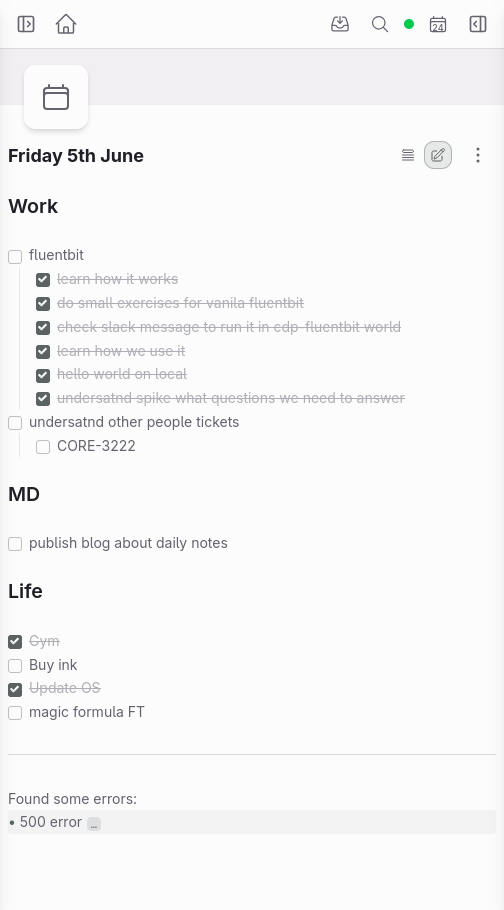
Before I had this system, I did two things that I think a lot of people will recognise. The first was just ignoring it and trusting my memory. We all know how that ends: I’d remember something when it was already too late, forget about an interesting book, or miss a task someone was waiting on.
The other thing I tried was adding proper tasks to my to-do app or read-later app. I never got back to them, and the list kept growing. One time, I left a simple follow-up in that pile for two weeks before I noticed it again.
That’s why daily notes matter. Not just any notes. We don’t want to accumulate hundreds of things to do. We only want to capture things that are semi-structured: not projects, not formal tasks, but things we need or want to do today or on a specific day in the future. (In 3Monads you can tap a future date, add a note, and it shows up when that day arrives!)
- Go to 3Monads (I’m the founder, so take the recommendation with that in mind, but any tool that creates a new empty note each day works; I used Roam Research in the past and that works well too, and Obsidian with the Daily Notes plugin is another solid option)
- Register if you don’t have an account, or log in
- Open Daily Note
- Write down everything you want to do today
- Use rich markdown syntax to change bullets into checkboxes (Ctrl+Enter on Windows and ⌘+Enter on Mac)
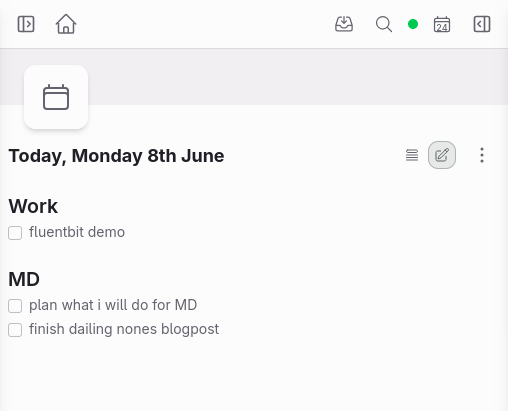
This is one of my favourite productivity and creativity boosts. It’s very simple and works even for productivity sceptics. Everyone I’ve recommended this to has given me positive feedback. I use it in the morning, mainly to prepare for standups and to sort out what I need to do at work today, what I plan to learn, and what I plan to do with side projects.
Roam Research and Obsidian are note-taking systems first. Any escalation from a note to something bigger, like a task or a project, requires switching to a different tool. If you want everything in one place, 3Monads was built specifically to remove that friction.
On top of my daily notes, I have my Execution System in the 3Monads app. That means some items are proper tasks I keep under specific projects, with due dates, just one click away. I can easily move items between the two: if a bullet grows into something that needs repeating, has a future deadline, and will take real time, I promote it to my Execution System as a task if it’s small, or a project if it’s big.
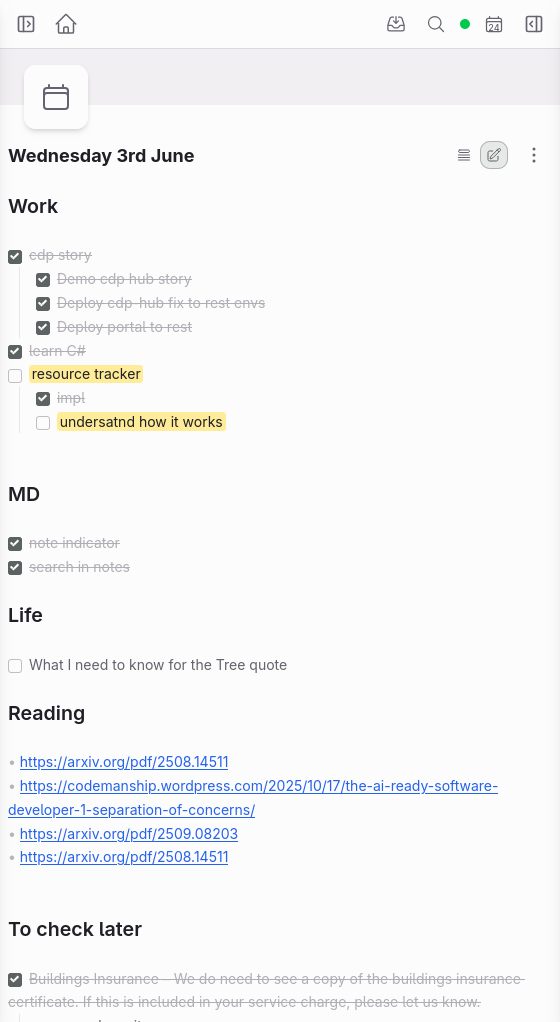
Daily notes are also great for review. I can look back a few days and see what I was busy with. It’s very useful during weekly reviews to see where my time went and decide what’s still worth doing. (I tend to uncheck and convert items back to bullets if I’m no longer pursuing them.)
I also use it to queue articles and blog posts I want to read on a specific day. Instead of a long read-later list, I have a few links for that day. When I come across something interesting and don’t have time right now, I add it to that day’s note. If I still haven’t read it, it comes up during my weekly review.
This simple habit improves your productivity with almost no cost. Pretty soon you’ll feel more relaxed because you’ve offloaded everything from your brain, and you’ll be able to track your progress through the day. Because each new day starts with a blank page, you won’t be scared by a pile of unfinished tasks. Open a note now and write the three most important things you need to do today.
References
- Zeigarnik effect, Wikipedia
- Consider it done! Plan making can eliminate the cognitive effects of unfulfilled goals. Masicampo & Baumeister, 2011
- How the Zeigarnik effect impacts everyone daily, Psychology Today